News Blog


Stay Up to Date on the Latest CAMM News

Go Back to Blog Page

The Mariners’ Museum Names New President and CEO

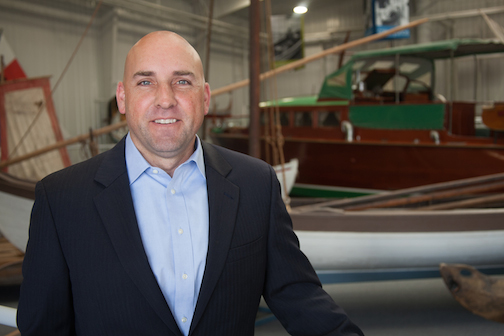
howard_hoege-lores

NEWPORT NEWS, Va. – The Mariners’ Museum and Park’s Board of Trustees has named Howard H. Hoege III the new President and CEO. Hoege has been acting as the interim President and CEO since May 1 and also helped lead the Museum’s strategic planning process as a consultant in 2015.

The announcement was made by Board of Trustees Chair Anne Conner in late September. Conner was instrumental in bringing Hoege on board. “The Museum is fortunate to have such a visionary and transformational leader to take the institution, staff, and volunteers in a new direction, which will better serve our region and beyond,” said Conner. “The Board selected Howard because he possesses the passion and ability to energize the Museum and bring greater international awareness to our unrivaled collection.”

Hoege graduated from the U.S. Military Academy, West Point, in 1994 and was commissioned as an infantry officer in the U.S. Army. He later earned his law degree from the University of Virginia School of Law and served as an Army JAG officer in Tal Afar, Iraq, and elsewhere. After leaving the service, Hoege was a counsel on the staff of the U.S. Senate Armed Services Committee and later an Assistant Dean at UVA’s Frank Batten School of Leadership and Public Policy. Before his current role as the President and CEO of The Mariners’ Museum and Park, Hoege founded a consulting firm that advised clients on the intersection of leadership development, strategy, and culture in organizational and civic contexts. Hoege’s wife of 22 years, Cinda, is a small business owner, and the couple has two children.

When Hoege talks about The Mariners’ Museum and Park, his message is simple: “For us, it begins and ends with our purpose: We connect people to the world’s waters – to our maritime heritage – because through the water, we are connected to one another.” For Hoege and the staff and volunteers at the Museum, the positive promise of building strong community through water is not only relevant for Newport News and the Peninsula, but for Hampton Roads, the nation, and the world. “Every day, we see and hear news of the forces that tear our communities apart, that separate us. We believe that The Mariners’ Museum has a very powerful narrative to tell about about where we have come from as a maritime people and nation and the forces that bind our community together,” said Hoege.

Acting on that purpose, The Mariners’ Museum and Park reduced its admission price to one dollar during the month of August as a way to make the Museum more accessible to those in the community who might not otherwise be able to afford admission. Tens of thousands of people visited the Museum during the month.  According to Hoege, “Our collection is deep enough and broad enough to tell the powerful human stories of the cultures of our local, national, and international communities.”

Submitted by Crystal Breede, The Mariners’ Museum, October 4, 2016
Eric Applegarth retires from CBMM

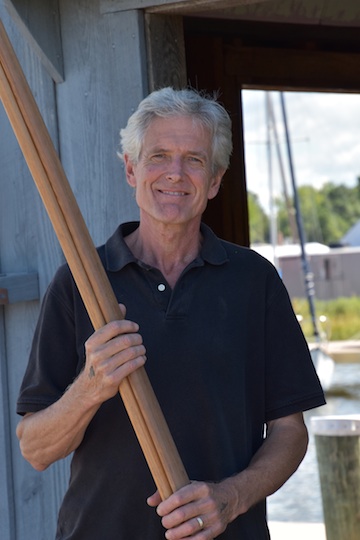
cbmm_applegarthretires
Photo courtesy Chesapeake Bay Maritime Museum

Long-time Chesapeake Bay Maritime Museum employee Eric Applegarth of Claiborne, Md. recently retired after 28 years of service. Applegarth worked as the Exhibits Specialist at CBMM, creating diverse props, art, and structures from his various creative talents, including woodcarving, metal-working, and painting.

Connected to the Eastern Shore and the Chesapeake Bay through a long line of heritage and through personal interest in what the Bay has to offer, Applegarth joined CBMM in 1988 after a few years of part-time work.

“Eric’s impact can be seen in virtually every corner of CBMM, from the perfectly cluttered decoy carver’s shop in our Waterfowling exhibition, to the metal outline mannequins in At Play on the Bay and the carved wooden faces and hands of the crew on the skipjack E.C. Collier in Oystering,” says CBMM Chief Curator Pete Lesher. “Eric’s cheerful willingness to do absolutely anything that needs to be done, his self-deprecating humor, and his sunny demeanor made him the most beloved member of CBMM’s staff for more than a quarter of a century.”

In his retirement, Applegarth will spend time in Claiborne, Md., and in New Haven, Ct., with his wife Michelle Zacks, an associate director at Yale University. With hopes to continue his passion for art and carpentry, Applegarth plans on volunteering with New Haven’s local museums and will stay connected to CBMM through continued work on exhibitions.

“I’ve really enjoyed the challenge of creating non-technical interactives to continue the story line of CBMM’s exhibitions,” says Applegarth. “I’ve also enjoyed the time that I’ve spent growing up along the Chesapeake, doing the things I love—from trapping muskrats, to boatbuilding, and working with watermen.”

Submitted by Tracey Johns, CBMM, September 29, 2016

USS Monitor Center receives IMLS grant

Newport News, VA – The Mariners’ Museum is one of 206 museums in the U.S. and three in Virginia to be awarded an Institute of Museum and Library Services (IMLS) Museums for America collections grant. A highly competitive program, the USS Monitor Center’s proposal was chosen from a pool of 548 applications; the $27,823 grant will be matched with non-federal funds.

“Museums play a vital role in their communities supporting experiences and inquiry for people of all ages, fostering civic engagement, and serving as stewards of collections that represent the nation’s cultural, historical and scientific heritage,” said IMLS Director Dr. Kathryn K. Matthew. Matthew stated that this federal support will help museums all over the country, “enabling their highest level of public service.”

turret-er-system

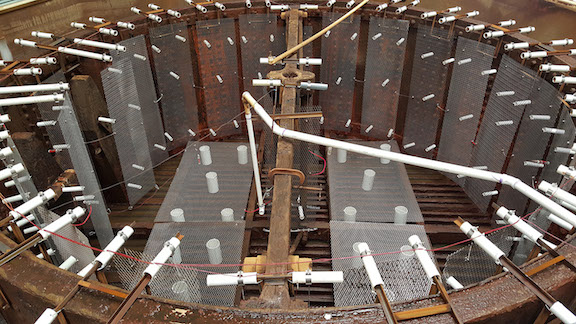
Conservation of the USS Monitor’s revolving gun turret will be monitored by a new electrolytic reduction (ER) computer monitoring system made possible in part by the Institute of Museum and Library Services. Photo courtesy of The Mariners’ Museum.

This grant will allow the Museum to purchase, install, and operate a new electrolytic reduction (ER) computer monitoring system to support the conservation of the iconic revolving gun turret from the USS Monitor, housed in the USS Monitor Center’s Batten Conservation Complex.

Will Hoffman, senior conservator/conservation project manager said, “The use of ER is a major part of  the turret’s conservation treatment; which involves the use of electrochemistry to breakup corrosion and free trapped chlorides embedded within the object’s surface.  To determine the effectiveness of the process and identify when adjustments need to be made, the artifact is constantly monitored through the use of a computer system. However, the hardware and software of the current system have become obsolete and technological support is no longer available. The new system, funded through the grant, will allow our conservators to get better real-time data and enable more accurate tracking of the treatment process over time. The resulting data can then be shared to expand the body of conservation knowledge that exists within the field, benefiting conservation and museum professionals around the world, as well as visitors to The Mariners’ Museum, and public audiences reached by lectures and web content.”

About IMLS: The Institute of Museum and Library Services is the primary source of federal support for the nation’s 123,000 libraries and 35,000 museums. Our mission is to inspire libraries and museums to advance innovation, lifelong learning, and cultural and civic engagement. Our grant making, policy development, and research help libraries and museums deliver valuable services that make it possible for communities and individuals to thrive.

Submitted by  Jenna Dill, The Mariners’ Museum, September 29, 2016 

Call for Session Proposals Now Available

The CAMM Board has begun an earlier timetable for conference planning this year. The deadline for session proposals has been moved up to December 2, 2016, so that speakers have plenty of time to get necessary travel approvals after their December 16th notification of acceptance. Please submit sessions with topics of interest to the CAMM community by downloading the online form.

legos carrie Pete
2016 education session included a Lego workshop

San Francisco Maritime NHP, our conference host, has announced that the conference hotel will be the Argonaut Hotel located on Fisherman’s Wharf within walking distance of all conference activities. The Argonaut is offering a special rate (the normal government rate) of $267 plus tax. This special rate will only be available until they run out of the contracted rooms, or March 27, whichever comes first. Call the hotel at 800-790-1415 to make your reservation and request the Council of American Maritime Museums Annual Conference rate.

There are many other hotels in Fisherman’s Wharf, from basic to luxury, within walking distance of the Park. A hostel is located just west of the Park, also within walking distance.

Parking is very limited so car rentals are discouraged.

The three-day (April 19-21, 2017) registration rate of $195  will cover all sessions, breakfasts, two box lunches, evening reception, and final dinner.  The one-day rate is $110. Optional field trips are planned for Saturday, April 22, 2017, and possibly Tuesday, April 18. Registration will start January 2, 2017. Rennie travel grants are available to staff at CAMM member institutions.  See our annual conference webpage for the application.

USGS Research Vessel Polaris Up for Auction

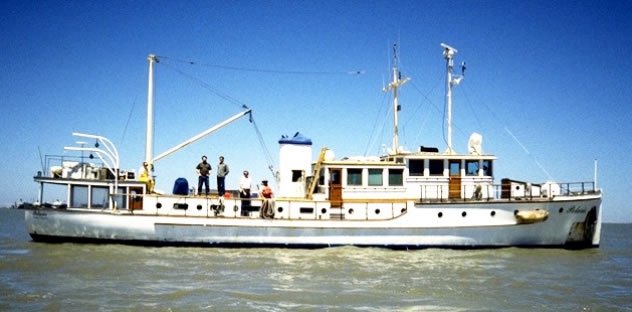
Since 1966, the U.S. Geological Survey (USGS) has been conducting ship-based scientific studies aboard the Research Vessel (R/V) Polaris.  It is bittersweet to announce the end of an era for the R/V Polaris with USGS but an exciting opportunity for yet another page of history to be added to the vessel under new ownership.

polaris
Photo of R/V POLARIS from USGS website

GSA will conduct an auction for the R/V Polaris which is scheduled to run from September 19, 2016 to October 4, 2016.  To access the auction site, visit www.GSAAuctions.gov and search under the category “Boats and Marine Equipment”. 

Submitted by Robbyn Jackson, September 16, 2016

Member Update – New Exhibit on Polynesian Voyagers

Newport News, VA – The Mariners’ Museum and Park’s newest exhibition Polynesian Voyagers opens on Saturday, October 1, 2016, in conjunction with Hokule‘a’s second visit to Hampton Roads. This exhibition will feature the time-honored navigational skills of the Polynesian navigators who relied on their knowledge of waves, winds, stars, and nature instead of modern instruments.

DCIM100GOPROG0033340.
Courtesy of The Mariners’ Museum

In collaboration with Hawaiian educators, the Hokule‘a crew and staff, and the Polynesian community, this new exhibition is designed to evoke the feeling of what it is to be a voyager. Guests will encounter displays demonstrating the origin of the Polynesian culture and community and how they are inherently maritime focused. With an emphasis on navigational techniques that precede technology, the exhibition will guide visitors through the story of exploration and settlement of the vast Pacific islands.

Polynesian Voyagers will feature the traditional supplies and methods encountered on a Polynesian voyaging canoe, and guests will be able to listen to Polynesian chants that would have been used in ancient times to share history among civilizations without a common language.

Hokule‘a will return to Newport News in mid-October. The double-hulled voyaging canoe will be brought to The Mariners’ Museum by truck where she will then go through general maintenance and repairs. There will be opportunities for Museum visitors to interact with Hokule‘a crew members and see the canoe up-close. Times and dates will follow in another release once Hokule‘a’s schedule is finalized. Tentative date for her arrival to the Museum is October 14, but this is subject to change.

The Mariners’ Museum and Park would like to thank the City of Newport News and Virginia Foundation for the Humanities for sponsoring Polynesian Voyagers.

Submitted by Jenna Dill, The Mariners’ Museum, September 12, 2016

NHHC Seeks Museum Curator

This position is located in the Curator Branch, Naval History and Heritage Command (NHHC), at the Washington Navy Yard.  The Curator Branch is responsible for the management of Navy properties of historical and inspirational value, including artifacts, shipboard equipment, ordnance, uniforms, photographs and memorabilia.  This responsibility encompasses acquiring, accessioning, preserving, storing, accounting for and distributing to eligible recipients the properties in the Navy’s historical collection.

For full job announcement see https://www.usajobs.gov/GetJob/ViewDetails/450640900/

Submitted by Jeff Bowdoin, Deputy Head, Curator Branch, Naval History and Heritage Command on September 16, 2016

U.S. Lighthouse Society Awards 2016 Preservation Grants

A total of $35,000 was awarded in the second year of the Lighthouse Preservation Grants Program, drawing on the interest from a still-growing investment fund that the U.S. Lighthouse Society has committed to increase through the years so that more and larger preservation grants can be made.

morris-island-sc-2009-1
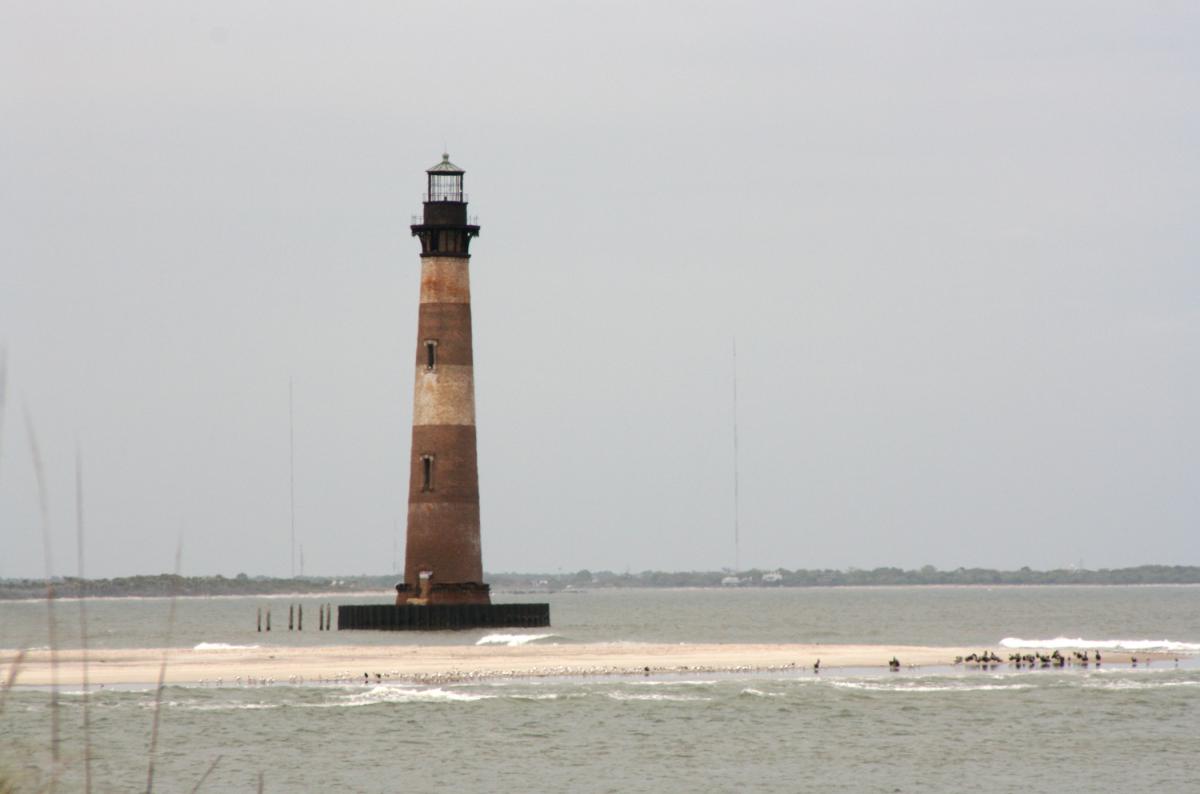
Morris Island Lighthouse

The Save the Light Foundation in Charleston, S.C., will use a $10,000 grant from the Society’s corporate partner, the SeaPak Division of Rich Products Corp., St. Simons Island, Georgia, to fund a detailed study of the very historic but erosion-threatened and decaying Morris Island Lighthouse.

The Morris Island project was a finalist in this year’s grants program, and was selected by the seafood company for its first program donation. The Charleston group will use the grant to gain a definitive assessment of the condition of the cofferdam-protected lighthouse and determine what steps can be taken, in what order and at what cost, to preserve the structure. International Chimney Corp., movers of the Cape Hatteras Light and other lighthouses, will do the work.

spring-point-ledge-me-2006_0
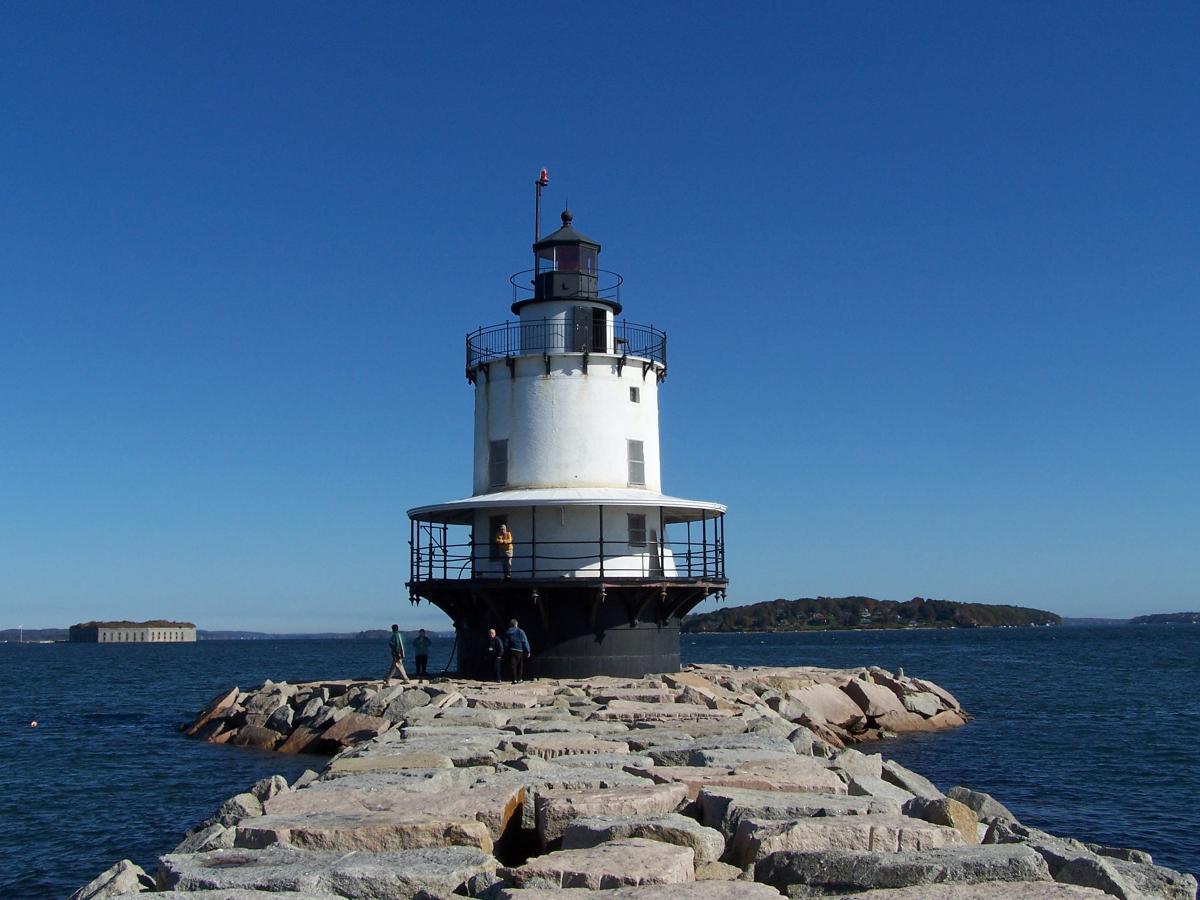
Spring Point Ledge Lighthouse

A $9,000 grant was awarded to the Spring Point Ledge Lighthouse Trust in Maine to replace the lantern vent ball on the breakwater lighthouse and repair damage in the lantern caused by water intrusion. The entire project will cost $20,700.

On the Great Lakes, the Michigan Lighthouse Conservancy will use a $9,000 grant to complete a $32,375 project to fabricate and install damaged or missing parts of the handrail system in the tower and on the lantern gallery at the Muskegon South Pierhead Lighthouse.

muskegon-pier-mi-2010
Muskegon South Pierhead Lighthouse
pensacola-fl-3
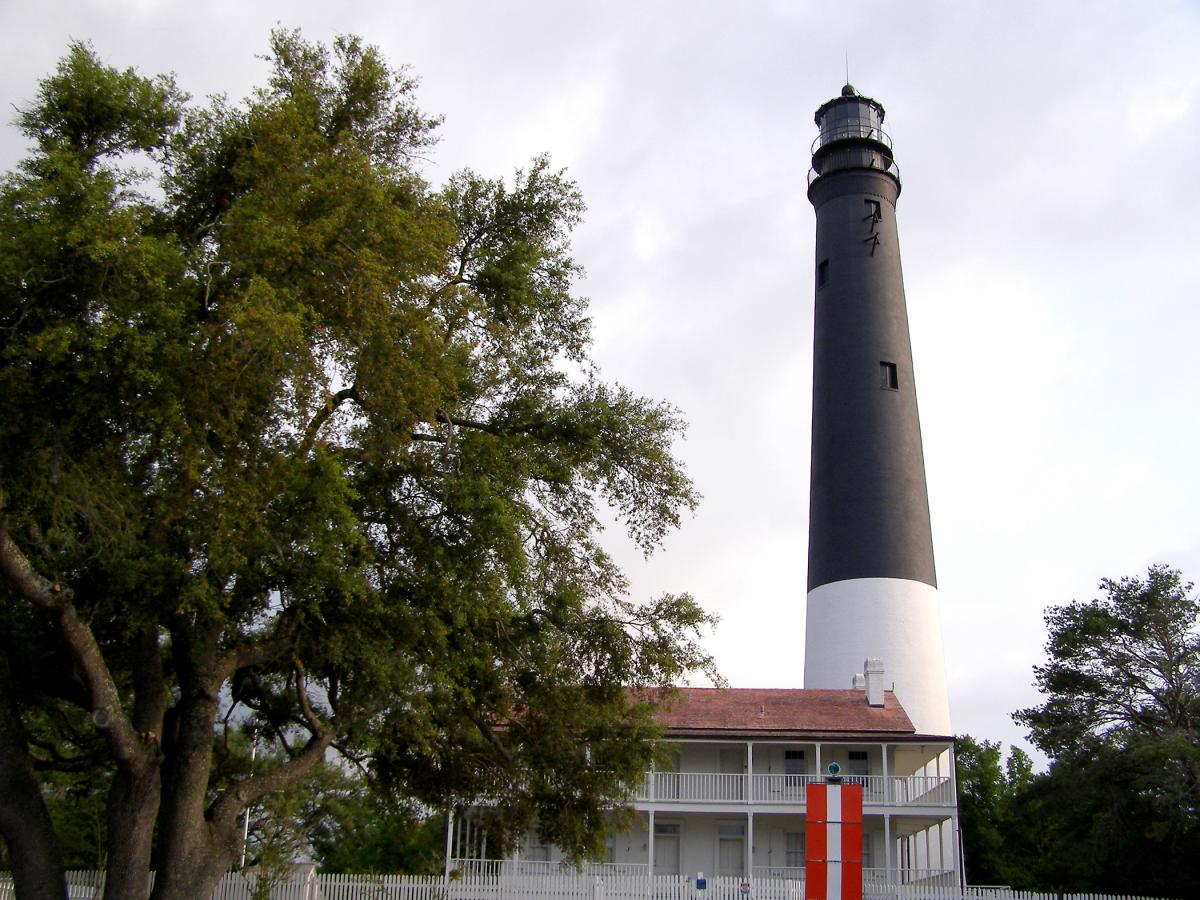
Pensacola Lighthouse

A $7,000 grant will be given to the Pensacola Lighthouse Foundation to restore a long-lost iron pedestal to the top of the lighthouse and use it to support a lens that now is suspended from the lantern roof. The pedestal was found a few years ago in the woods near the tower, and has been restored. The grant will go toward the $17,589 project to place it back in its proper location to support the lens and curtail the structural damage caused by the current system.

This year’s grants mark a slight increase from last year’s $31,000 in assistance to efforts to repair the lantern and replace a ventilator ball on the Sentinel Island Lighthouse near Juneau, Alaska; to help replace windows and shutters at the Toledo Harbor Lighthouse in Ohio; and to start work on a detailed plan to restore the masonry basement at Race Rocks Lighthouse in Long Island Sound near New London, Connecticut.

037-boston-harbor-2
Boston Harbor Lighthouse

In addition, the Society’s program will administer a second grant from its first corporate preservation partner, the Lands’ End clothing company of Wisconsin. Last year, Lands’ End committed funding to launch the Society’s detailed study of preservation needs at the Alcatraz Island Lighthouse, a Society project in San Francisco Bay. This year, the Society and Lands’ End leaders traveled in late July to Little Brewster Island in Boston Harbor to present an initial $30,000 check to restore the foundation of the Boston Light’s iconic boathouse; the work will allow the boathouse to reopen to the public, and the gift celebrates the 300th anniversary of the country’s first lighthouse.

At this point the Society’s program is open only to not-for-profit groups, with a maximum grant amount of $10,000. As the dedicated preservation fund grows, more grant money will be made available for future projects. Information on donating to the fund or applying for future grants may be found on the Society’s website.

Submitted by Candace Clifford, September 8, 2016

Quick Links


Home

Annual Conference

Become a Member

News Blog

Resources

Follow CAMM on Facebook button

Get In Touch


Find Members by Location

Find Members by Name

Send Us a Message