The Mariners’ Museum and Park is seeking a new President to lead the Museum into a new era. The President is responsible for increasing the visibility, prominence, financial resources, relevance and impact of The Mariners’ Museum and Park. S/he must be a leader who can garner respect and support of donors, government leaders, other non-profits and experts in the field. This individual must know how to build a world-class operation, develop and nurture partnerships, and be a catalyst who can lead and motivate others while creating excitement and energy around The Mariners’ Museum and Park and all its potential.
The ideal candidate will possess a minimum of ten years in a leadership role in a profit or not-for-profit organization, preferably in a Museum, with a proven track record in leadership, revenue generation, building new business lines, and motivating staff and volunteers to achieve new levels of excellence. This individual must be a passionate, creative leader and team builder. The new President will report to The Mariners’ Museum Board of Trustees.
The Council of American Maritime Museum’s Board is delighted to welcome four new members!
Channel Islands Maritime Museum, Oxnard, California
Institute of Nautical Archaeology, College Station, Texas
Maritime Industry Museum at Fort Schuyler, Bronx, New York
Ocean Institute, Dana Point, California
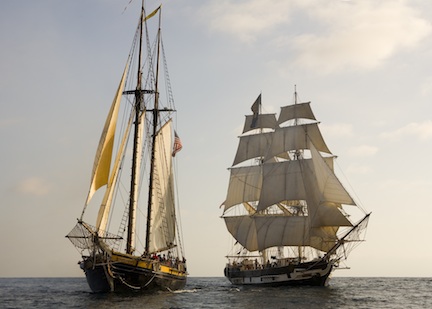
The Ocean Institutes’ tall ships SPIRIT OF DANA POINT and Brig PILGRIM. Photo courtesy of the Ocean Institute.
According to their website, “The Ocean Institute, founded in 1977, educates 250,000 visitors annually through over 60 marine science and maritime history programs. Located on 2.4 acres in the Dana Point Harbor, adjacent to a Marine Life Conservation Area, the facility is an ocean education center that offers in-depth Marine Science, Maritime History and Outdoor Education programs.
The Institute includes state-of-the-art teaching labs, the spectacular Maddie James Seaside Learning Center, two historic tall ships, and an oceanographic research vessel. Immersion-based field trips range from one-hour science labs to multi-day programs at sea and at the Lazy W Ranch, in the foothills of the Santa Ana Mountains. All programs are designed to maximize immersion, spark curiosity, and inspire a deep commitment to learning.”
Affiliated with the Texas A&M University, the Institute of Nautical Archaeology is based in College Station, Texas. A non-profit international research organization “committed to locating, excavating, recording, preserving, and publishing archaeological sites of maritime significance—including wrecked and buried ships, submerged ruins, and their associated artifacts, INA was founded over 40 years ago by Dr. George Bass, who in the 1960s pioneered the science of archaeological excavation under water. INA conducts work around the globe on shipwrecks and submerged sites. INA’s projects represent all historical periods and geographic regions, from the 14th-century B.C. Bronze Age shipwreck at Uluburun, Turkey to the 19th-century A.D. side-wheel steamboat Heroine in Red River, Oklahoma.”
Channel Islands Maritime Museum Docent Jerry Leckie talks to a group of students from Hathaway School. Photo courtesy Channel Islands Maritime Museum
The mission of the Channel Islands Maritime Museum, Oxnard, California, is to “provide a rewarding museum experience based on the age of sail and to enhance the understanding of our rich maritime heritage through world-class maritime art, unique ship models, dynamic exhibits, and educational programs.” The museum offers a wide range of educational tours and activities for students in grades 3 through 12, as well as field trips and a summer education program. Permanent exhibits include seascape paintings and a variety of ship models–some carved by French prisoners-of-war from soup bones.
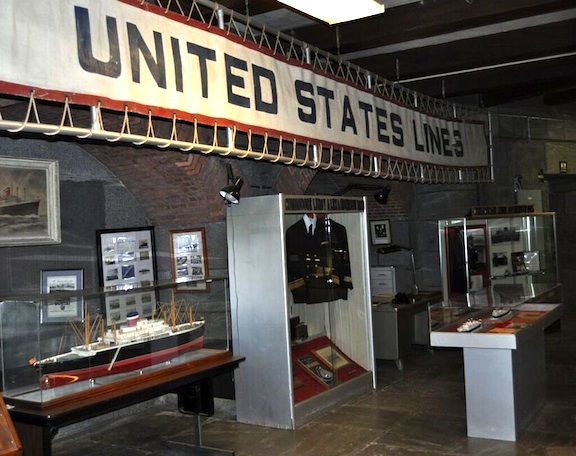
Courtesy Maritime Industry Museum at Fort Schuyler
The Maritime Museum at Fort Schuyler is housed on the campus of the State University of New York (SUNY) Maritime College at historic Fort Schuyler, The Bronx, New York. According to their website, “Touring the museum is like strolling through passages of time. The museum offers one of the largest collections of maritime industry materials in the nation and is displayed chronologically. The main exhibit area located on the second floor is entitled ‘The Evolution of Seafaring’ and encompasses the history of seafaring from the ancient Phoenicians to present day steamship companies and passenger ship lines. Exhibits in the area include paintings, models of early sailing vessels, clipper ships, turn of the century vessels up to and including the present day, as well as tools and navigational instruments of bygone days to modern times.”
Submitted by Candace Clifford using extracts from these members’ websites, April 12, 2016
Steve White became president of the International Congress of Maritime Museums (ICMM) at their November 2015 meeting in Hong Kong. Twenty countries were represented at this meeting hosted by the Hong Kong Maritime Museum. In his President’s Page message after the meeting, Steve stated “In Hong Kong, we explored the past and the heritage of trade while looking from the present and into the future in a port that is one of the global leaders in maritime trade today. In this environment, we were confronted with the juxtaposition of past and present, and thanks to a well-planned Congress, including our trip to Macau and to several museums in Macau and Hong Kong, the overall program illuminated our understanding of these parallel worlds.”
The next Congress is set for October 15-20, 2017, in Valparaiso, Chile. According to Steve, “It will be our first time in South America, and I ask all members to please put our bi-annual event on your calendar and to plan for the expense in your budgets. The program planning committee is already beginning its work under the direction of Kristen Greenaway (Chesapeake Bay Maritime Museum). The theme for the program and the congress is DISCOVERIES! which is appropriate for our first congress in South America as we discover the rich and diverse maritime history of a country that includes the iconic Cape Horn. Please visit our website from time to time to see more information regarding this important Congress.”
Extracted from the ICMM newslettter and website by Candace Clifford, April 11, 2016
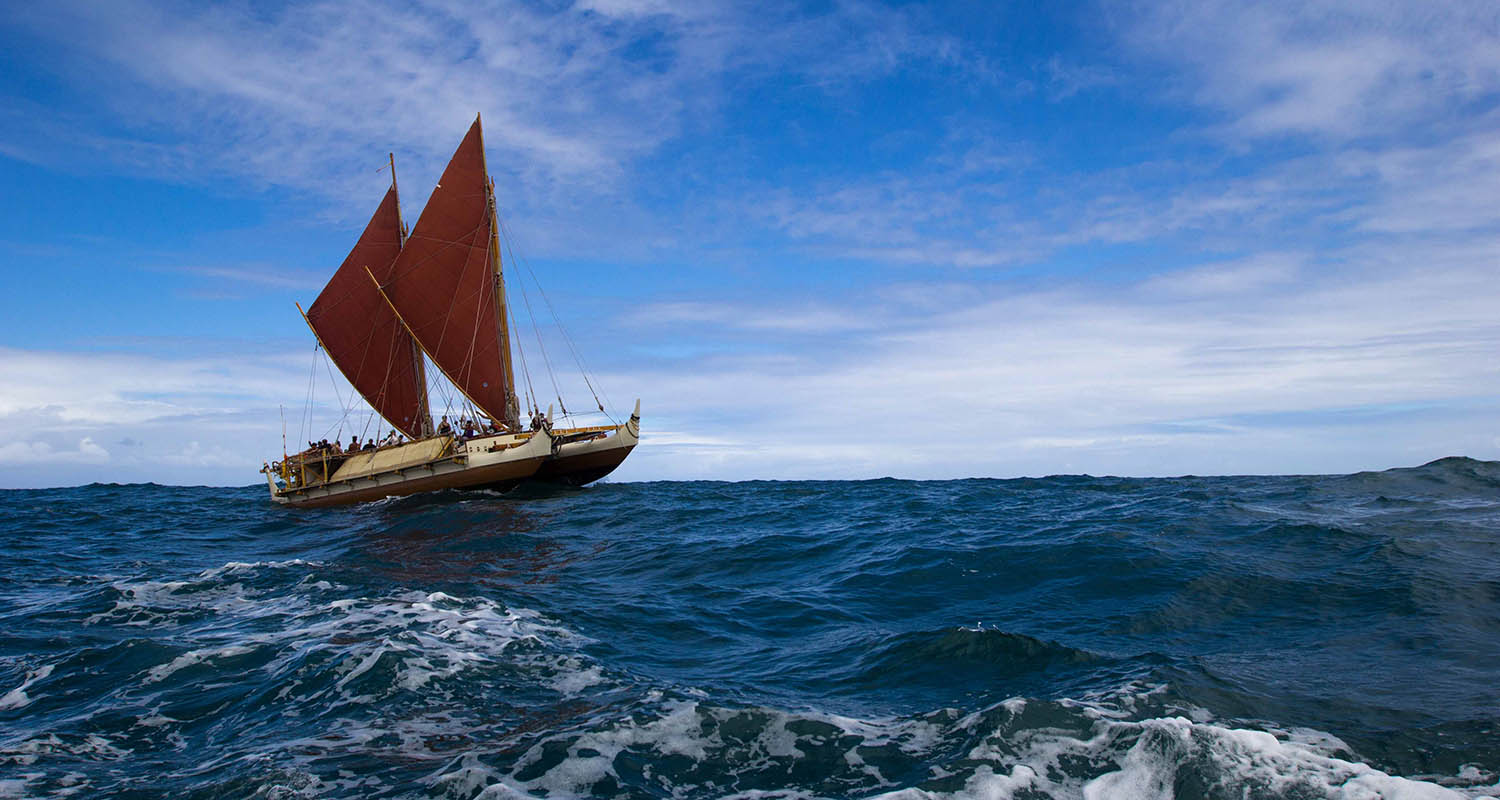
The Polynesian voyaging canoe Hokule’a (“Star of Gladness” in Hawaiian) is circumnavigating the globe on a voyage whose goals are as impressive as they are important. Hokule’a was built by the Polynesian Voyaging Society in the 1970s, more than 600 years after any other voyaging canoe existed.
Designed and sailed using skills that very nearly went extinct, Hokule’a seeks the wisdom of all indigenous peoples in a search for ideas on dealing with global concerns applied on a global scale. Appealing particularly to students and their communities, Hokule’a brings attention to the message of Mālama Honua – “to care for the Earth” in Hawaiian.
Hokule’a will be welcomed into Hampton Roads waters by a flotilla on Friday, April 22. She will then stay docked in Newport News for the Earth Day Celebration on Saturday, April 23 at the James River Fishing Pier. The celebration will include tours of Hokule’a, educational activities for families, and chances to meet the crew members. On Sunday, April 24, Hokule’a will sail to Yorktown for a traditional welcoming ceremony with Native American tribes followed by an afternoon celebration and tours of Hokule’a.
Throughout the visit, Hokule’a’s crew will participate in multiple public programs. On Thursday, April 28, the crew will deliver a special lecture on Traditional Polynesian Wayfinding at the Museum. On Friday, April 29, the Museum will host Exploring the Seas Homeschool Day with the Polynesian Voyaging Society. There will also be special opportunities for Hampton Roads students to visit with the crew in their own classrooms.
Hokule’a will remain at Riverwalk Landing in Yorktown until May 8, when the canoe will continue sailing north, eventually visiting Washington, D.C., in time for a possible presidential declaration of National Oceans’ Month.
For more information about Hokule’a’s visit please go www.marinersmuseum.org/hokulea-events/. Or, you may contact Anne Marie Millar at (757) 591-7748 or email amillar@marinersmuseum.org.
Submitted by Jenna Dill, The Mariners Museum, April 11, 2016
Mystic, Conn. (April 7, 2016) – Mystic Seaport announced today that Nicholas R. Bell has been named Senior Vice President for Curatorial Affairs, a new position at the Museum that will be responsible for the care, management, strategic development, and exhibition of the Museum’s collections. Bell will assume the position June 1, 2016.
Bell is presently The Fleur and Charles Bresler Curator-in-Charge at the Smithsonian American Art Museum’s Renwick Gallery in Washington, DC, where he led the Gallery’s recent relaunch following a $30 million, two-year renovation. The reopening exhibition, entitled “WONDER,” explores the museum’s value to American culture and identity by presenting nine gallery spaces to site-specific installations by leading contemporary artists. The innovative project brought success and tremendous acclaim to the Renwick—museum attendance has increased 1,000 percent since its reopening.
“We are very proud to have a curator of Nicholas’s caliber join Mystic Seaport. We believe his deep knowledge of material culture, understanding of the public audience, and demonstrated leadership and creativity will take our collections and exhibitions program to a new level,” said Steve White, president of Mystic Seaport. “The combination of the Thompson Exhibition Building opening this fall and this new leadership position truly signify that Mystic Seaport is moving into a new era of exhibitions.”
During his eight years at the Renwick, Bell curated six major exhibitions. The diverse projects included the thematic “WONDER;” a highly praised generational survey “40 under 40: Craft Futures,” organized to celebrate the Renwick’s 40th anniversary; the monographic “Untitled: The Art of James Castle;” and the presentation of groundbreaking research in “A Measure of the Earth: The Cole-Ware Collection of American Baskets.”
Bell’s vision expanded the Renwick’s focus from a narrow definition of craft to include a broad array of creative practices illustrating skilled making as a multifaceted approach to living in the modern world. He reinvigorated the museum’s permanent collection through targeted purchases and gifts, including the gift of a landmark Dale Chihuly chandelier, the acquisition of the largest public collection of American revival baskets, and the second largest public collection of works by seminal self-taught artist James Castle.
Along with his curatorial accomplishments, Bell worked with the Smithsonian American Art Museum’s development team to raise funds to endow two curatorships and support the Renwick’s renovation. He also was part of a select group of Smithsonian experts who participated in TED talk-style presentations across the U.S. for the Smithsonian’s $1.5 billion capital campaign.
Bell has published seven books in the last five years, including six peer-reviewed exhibition catalogues and one edited anthology. He additionally positioned the Renwick as a center for scholarship with two international symposia in the past three years that have featured nearly 40 speakers.
”No matter how far we live from it, as Americans, the sea is bred in our bones. I believe the inclusiveness with which Mystic Seaport defines this relationship is the Museum’s greatest asset to building new connections with the public it serves,” said Bell. “Expanding on these connections is a thrilling opportunity, and I could not ask for a stronger team with which to embark on this adventure than the one already in place at the Museum.”
Bell earned a bachelor’s degree from Simon Fraser University in Vancouver, British Columbia, and a master’s degree from the Winterthur Program in American Material Culture at the University of Delaware. Bell, his wife, Allison, and their three children will be relocating to Mystic, Conn. this spring.
Submitted by Dan McFadden, Mystic Seaport, April 7, 2016
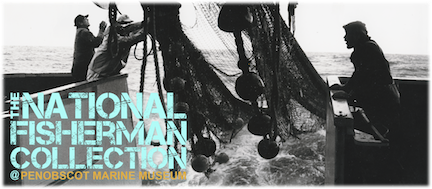
The first 5000 images in the National Fisherman Collection are now live. Ben Fuller is in the process of adding dates and locations to this group as well as reviewing the subject headings and search terms. Please contact him via bfuller@pmm-maine.org with any suggestions or corrections. He expects to have the next 5000 up early in the summer.
Submitted by Ben Fuller, Curator, Penobscot Marine Museum, April 5, 2016
As outlined in this Public Notice, NOEL LOVE GROSS, TRUSTEE OF TRUST B UNDER ARTICLE IIIB OF THE LAST WILL AND TESTAMENT OF NELSON G. GROSS is seeking interested qualified parties to enter into an agreement to remove the ferryboat Binghamton from its current site, in Edgewater, New Jersey, for the purpose of preservation and restoration. The Public Notice period will expire after 90 days, on June 29th, 2016. In the event that no qualified parties come forward within the 90 period to enter into an agreement to remove the entire vessel, components of the vessel will be offered to historical organizations and museums for curation.
The ferryboat Binghamton, a National Register structure, was constructed from 1904-1905. This vessel was one of six steam-powered screw-propeller, double-ended ferryboats built by the Newport News Shipbuilding and Dry Dock for the Hoboken Ferryboat Company. After her 62 years of service on the Hudson River between Hoboken and Manhattan, the ferryboat was sold and turned into a popular floating restaurant known as Binghamton’s in 1975. Unfortunately, the ferryboat is in poor condition due to damage sustained during Superstorm Sandy in October of 2012. The State of New Jersey has ordered the vessel’s removal for safety concerns.
Submitted by Teresa Bulger, Richard Grubb & Associates, April 1, 2016
Peter Stanford, one of the 1972 founding members of the Council of American Maritime Museums, died today. The National Maritime Historical Society has posted a tribute to their late President Emeritus on their website.
Stanford was the founding president of South Street Seaport Museum, New York, and was instrumental in saving numerous historic ships, including the Lightship Ambrose; Brigantine Black Pearl; Barques Elissa, Moshulu, and Peking; Schooners Ernestina, ex-Effie Morrisey and Lettie Howard, Liberty Ship John W. Brown, steam tug Mathilda, and Wavertree.
In addition to CAMM, Peter Stanford was involved with the evolution of the American Society of Marine Artists (1977), the American Ship Trust (1978), the Hudson River Maritime Museum (1979), and the National Maritime Alliance (1987). He also co-founded and supervised both OpSail 1976 for the nation’s bicentennial and the Statue of Liberty Parade of Sail in 1986.
A remarkable leader in the early days of ship preservation, Peter Stanford played a crucial role in bringing maritime heritage to the attention of the nation’s cultural resource community.
Submitted by Candace Clifford, using information from the National Maritime Historical Society posting, March 24, 2016
Photo courtesy Kalmar Nyckel Foundation, this year’s conference host.
This year’s CAMM conference, April 25-27, in Wilmington, Delaware, will be a great opportunity to interact with fellow maritime heritage professionals. The conference website has been updated with the preliminary program. The registration deadline, April 12, 2016, is less than a month away so make your plans to join us in Wilmington!